WhatsApp vs VoIP: Which Is Actually Better for International Calls?
Short answer: WhatsApp is free, so use it whenever the person you’re calling has WhatsApp and a decent internet connection. The moment you need to call a real phone number — a landline, a bank, an airline, a hotel, a government office, or a relative whose mobile data is spotty — WhatsApp cannot place the call. That is where a pay-as-you-go VoIP service (like VoixCall) takes over, for a few cents per minute.
We make VoixCall, so we have a clear bias here. Even so, if WhatsApp already covers everyone you call, you do not need to pay us or any other VoIP provider. Here is the honest breakdown of where each one wins.
Side-by-side comparison
| Feature | Pay-as-you-go VoIP (e.g., VoixCall) | |
|---|---|---|
| Cost | Free (uses Wi-Fi or mobile data) | Per minute: e.g., $0.027/min US/CA, $0.030/min UK landline, $0.080/min India mobile |
| Call landlines & regular mobiles | No | Yes, in 160+ countries |
| Call US 1-800 / toll-free numbers | No | Yes (routed via US network) |
| Does the other person need an app? | Yes, plus internet | No — rings their normal phone |
| Call quality dependency | Needs good internet on both ends | Needs internet on your end only |
| Caller ID | Your WhatsApp profile | Your verified phone number or a virtual number |
| Call recording & AI transcripts | No built-in recording | Optional recording ($0.003/min) + AI summaries ($0.02/min) |
| Group video calls | Yes, free | No (voice calling only) |
For a deeper feature comparison specifically against VoixCall, see VoixCall vs WhatsApp.
Where WhatsApp wins
- Zero cost for everyday personal calls: catching up with friends, family and colleagues who already use WhatsApp costs nothing over Wi-Fi.
- Video and group calls: WhatsApp handles video calls and multi-person family calls out of the box.
- End-to-end encryption for messaging and calls: ideal for private app-to-app conversations.
If your international calls are 100% app-to-app with people on solid Wi-Fi or 4G/5G, stop here and use WhatsApp.
Where WhatsApp breaks down (and VoIP wins)
1. Calling any business, bank, airline or government office
Hotels, hospitals, airlines, tax offices and bank fraud desks publish phone numbers, not WhatsApp accounts. When your card is blocked abroad or your flight is canceled, WhatsApp cannot dial +1 302-594-8200 or 1-888-280-4331. A VoIP dialer connects directly to those numbers from your browser or phone. (See our guides on calling your bank from abroad and calling US toll-free numbers from abroad.)
2. Reaching landlines and older relatives
Landlines are still standard for older parents in many countries, local offices, and clinics. Because VoIP terminates on the public telephone network, the person you call simply picks up their regular handset — no app, no smartphone, no Wi-Fi required. See how to call landlines internationally.
3. Calling someone on weak mobile data
WhatsApp is only as good as the weaker of the two internet connections. If you are on fiber in London or New York, but the person you’re calling is on patchy 3G in a smaller town, WhatsApp drops audio and lags. With VoIP, only your side uses the internet; the recipient receives a standard cellular or landline voice call.
4. Business calls where caller ID and notes matter
Calling a supplier, client or customs broker from a personal WhatsApp profile is not always appropriate — and many business contacts don’t share personal WhatsApp numbers. With VoIP you can display your verified phone number as caller ID, record the call where lawful, and generate call transcripts and AI summaries so reference numbers and agreed prices are written down automatically.
What VoIP actually costs (real 2026 numbers)
VoIP is not free, so it helps to look at actual 30-minute call costs rather than vague “from 1¢” claims. Using VoixCall’s published per-minute rates (checked November 23, 2026):
| Route | Per-minute rate | 30-minute call |
|---|---|---|
| US or Canada (landline or mobile) | $0.027/min | $0.81 |
| United Kingdom landline / mobile | $0.030 / $0.052 | $0.90 / $1.55 |
| Mexico (landline or mobile) | $0.030/min | $0.90 |
| India mobile / landline | $0.080 / $0.111 | $2.41 / $3.33 |
| Nigeria landline / mobile | $0.352 / $0.358 | $10.55 / $10.75 |
Notice that rates vary sharply by country and by landline vs. mobile. Check your destination in our cheap international calls directory before dialing.
The practical setup: use both
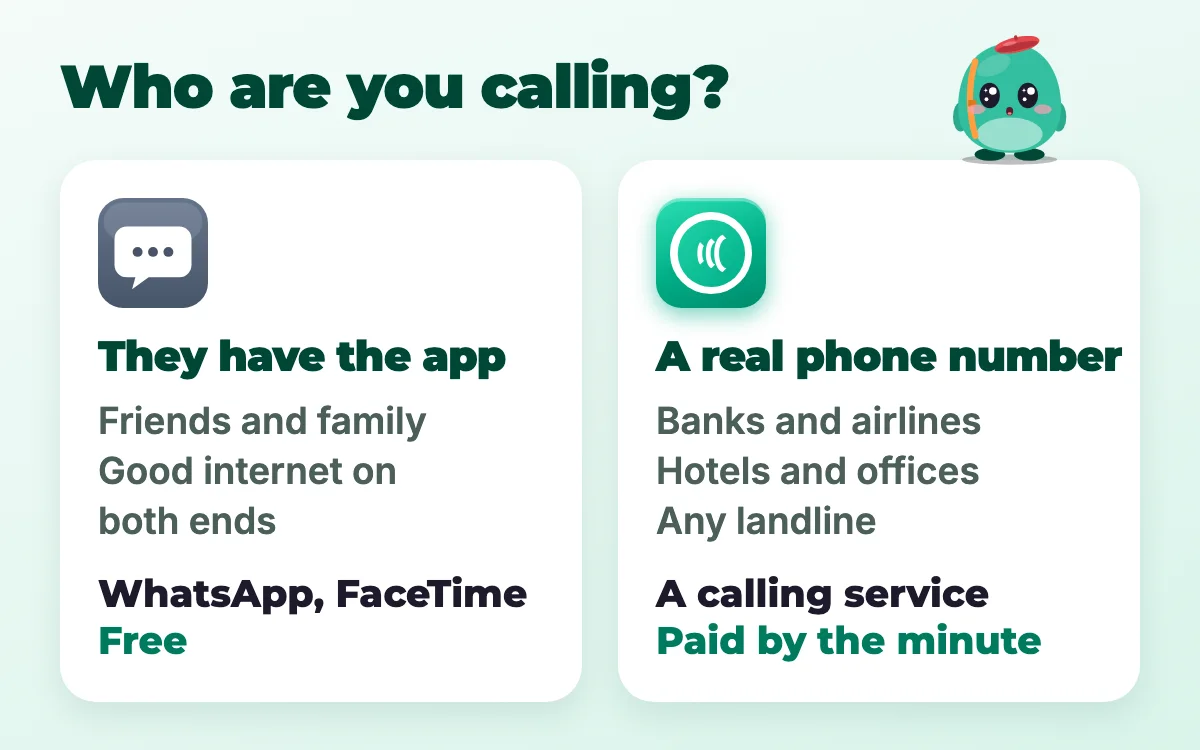
Most people who live or travel across borders don’t choose one over the other:
- Use WhatsApp for free daily calls and video chats with people who have the app and reliable internet.
- Keep a pay-as-you-go VoIP balance as backup for landlines, banks, airlines, toll-free numbers, and calls where the other person’s data connection won’t hold up.
Because VoixCall has no monthly subscription and credits never expire, you can keep $5 or $10 in your account and only spend it on the calls WhatsApp can’t make. Your first call is free in the browser or the iPhone and Android apps.
Related pages
Frequently asked questions
Can WhatsApp call a regular phone number or landline?
No. WhatsApp only calls other WhatsApp accounts over the internet. It cannot dial landlines, basic mobile phones without WhatsApp, banks, hotels, airlines or toll-free 1-800 numbers.
Is VoIP cheaper than WhatsApp?
No — WhatsApp calls are free (aside from your Wi-Fi or mobile data). Pay-as-you-go VoIP costs a few cents per minute ($0.027/min to the US/Canada, $0.030/min to UK landlines, $0.080/min to Indian mobiles on VoixCall) because it connects to real phone networks.
Why does a VoIP call sometimes sound better than WhatsApp?
WhatsApp requires good internet on both ends of the call. A VoIP-to-phone call only uses internet on your side and delivers the call over the local cellular or landline network on the other side, which is often more stable when the recipient has weak mobile data.
What is the best setup for international calling?
Use both. Keep WhatsApp for free personal calls with contacts who have the app and good internet, and keep a pay-as-you-go VoIP account with non-expiring credits for landlines, businesses, banks, airlines and relatives on weak data.